As part of the Sierra College community, you have a unique opportunity to share your stories, whether visual or literary, in the Sierra Journal. We hope to continue the journal’s legacy as a historical record of our community’s experience. Send us your words, photographs and art. We want to hear from you.
Format: Please format your work in Standard Manuscript Format. We prefer this format because it lends itself to readability in print and digital modalities and leaves room for editorial staff to make notes between lines and in the margins. At the very least, please format your work according to the following parameters:
Sans serif font, such as Courier or Times New Roman
12 pt. font size
Double-space between lines
One-inch margins all around
If you deviate from these formatting guidelines without a reason that is purposeful and clear to your reader, it may reduce your chances of being published in Sierra Journal.
In the case of poetry, please ensure that you set line breaks, stanza breaks, and other elements of format (e.g. concrete poetry) precisely as you wish it to appear in print.
Manuscript File: Attach your manuscript as a Word document. All students and staff have access to Microsoft Office through Sierra College and can be accessed via myApps.
Information to Include: Please let us know if the literature you submit is a reprint or a simultaneous submission. This is standard practice and can affect a work’s eligibility for publication. It’s fine if you want to include a brief cover letter by way of introduction but do not include a synopsis of your story.
IMPORTANT:Please do not include your name on the document itself as we adhere to a blind reading process (meaning we read works without knowing who wrote them to avoid potential editorial bias).
File naming: Use your first and last name, followed by an underscore (_) and a brief literary title. Example: pat-smith_dramaticsky.jpg
File names should contain no spaces or special characters. Use lowercase letters, numbers, and underscores only.
File names should contain no periods other than the one preceding the .jpg extension.
Literature Produced Using AI: Works produced using AI, LLMs, or machine learning will not be accepted. The Sierra Journal is interested in literature produced with “traditional elements of authorship,” as defined by the U.S. Copyright Office. Using basic editing tools like spell and grammar check, as well as AI generated prompts to develop your own story are acceptable; however, any generative use of AI to produce a story, such as AI modified and/or edited content, will not be accepted, as they do not represent the author’s own ideas, passions, and unique sensibilities and are infringements on or outright stolen ideas, passions, and unique sensibilities of others.
Permission to Publish: Work will be juried by students and faculty in English 22. If selected, the author agrees to have their work published in the Sierra Journal both in print and online. Artists’ work may also be used for promotional materials (social media, advertisements, inclusion on the SJ website, etc.).
The Sierra Journal welcomes submissions of photography, design, painting, drawing, sculpture, digital art, excerpts of graphic novels, and other forms of visual art. Images may be submitted in color or black and white. Submissions will be reviewed based on artistic merit and appropriateness for the content of the Sierra Journal and the academic environment.
Submission Guidelines:
You may submit up to 10 works total.
For sculpture and other three-dimensional artwork, submit one photograph of the artwork. This image will be considered for reproduction in the Sierra Journal.
Submit the highest-quality image that meets the file requirements below.
Digital File Preparation
File format: JPEG (.jpg)
Color space: RGB
Minimum image dimensions: 2000 pixels on the shortest dimension
Maximum image dimensions: 6000 pixels on the longest dimension
Maximum saved file size: 20 MB, or the largest practical file size supported by the submission system (Marketing and IT to review and determine this.)
File naming: Use your first and last name, followed by an underscore (_) and a brief image title. Example: pat-smith_dramaticsky.jpg
File names should contain no spaces or special characters. Use lowercase letters, numbers, and underscores only.
File names should contain no periods other than the one preceding the .jpg extension.
Use of AI Tools: AI-assisted tools may be used for basic image editing and retouching, such as adjustments to color, tone, contrast, sharpening, noise reduction, spotting, or similar corrections. Limited use of generative tools for image extension or background expansion is permitted, provided it does not add or substantially alter significant visual content. AI-generated imagery, or the use of generative AI to create significant subjects or visual content, is not eligible for submission. Submitted work should represent the original creative work of the artist or photographer.
Permission to Publish: By submitting work to the Sierra Journal, the artist grants Sierra College permission to reproduce and publish the submitted work in the Sierra Journal and in related digital or promotional materials associated with the publication. The artist retains copyright and ownership of their original work.
Selection Process
All submissions are blind-juried and selected based on artistic merit. While we recognize that this process is rigorous and discerning, we believe it ensures that only the most compelling, innovative, and skillfully executed works are featured.
Work will be juried by students and faculty in English 22. If selected, the author agrees to have their work published in the Sierra Journal both in print and online. Artists’ work may also be used for promotional materials (i.e., social media, advertisements, Sierra Journal web page, etc).
A Legacy Project at Sierra College
Since 1960, Sierra College students have guided the publication of the Sierra Journal, a historic project that meets several of the college’s core values, most specifically “support and model excellence and innovation in teaching, learning, scholarship, and creativity” by featuring work from current Sierra College students and employees.
First created in the English Department by faculty and students, the publication has gone through many forms and iterations. Initially titled Viewpoint (1960–1972), it transitioned to I Am (1973–1975), and finally to the Sierra Journal in 1976. The publication continued to be published annually until 2011–2012. It was published online in 2012–2013. Publication was suspended until it was resumed by the Sierra College Press in 2017–2018. Production was halted in the 2020-2021 school year due to the Covid-19 pandemic and resumed once again in 2021-2022.
Today, the Sierra Journal continues as an example of the creative and collaborative spirit that exists at this institution. The Sierra College Press Board of Directors eagerly voted to act as a reliable and sustainable supporter of the Sierra Journal. United with the Sierra College Press, a team of dedicated faculty members have devoted time to jurying student work, vetting submissions, and facilitating design and production via various committees, clubs, and academic courses. Through this network of support, this student-driven publication continues to thrive and serves as a reflection of time, place, and community. In 2025, the Sierra Journal received a generous endowment from Michael D. Price, ensuring the continued publication of future editions and supporting the creative voices of our campus community.
In 2025, the Sierra Journal received a generous endowment from Michael D. Price, a Sierra College alum and retired Sierra College employee, ensuring the continued publication of future editions and supporting the creative voices of our campus community.
Copies of the Sierra Journal can be purchased at the Sierra College bookstore on the Rocklin campus. Copies of the entire run of this literary and arts publication can be found in the Sierra College Library and Archives on the Rocklin campus.
Awards
2025 Edition
Award of Excellence – National Council of Teachers of English (NCTE)
2024 Edition
Most Outstanding Community College Literary Magazine – American Scholastic Association
Superior Ranking – National Council of Teachers of English (NCTE)
2023 Edition
REALM First Place – National Council of Teachers of English (NCTE)
Silver Addy Award – American Advertising Awards (Sacramento)
Thank You to Our Generous Sponsors
Associated Students of Sierra College
Sierra College Friends of the Library
Sierra College Liberal Arts Division
Sierra College Office of Instruction
Sierra College Press
Sierra College Patrons Club
Sierra College President’s Office
Be Part of the Creative and Collaborative Spirit
We are always looking for editors, designers, and illustrators to help us produce the Sierra Journal. In addition to submitting works for publication, you can get involved with the layout of the publication through our Applied Art and Design (AAD 53 – Publication Design II) course.
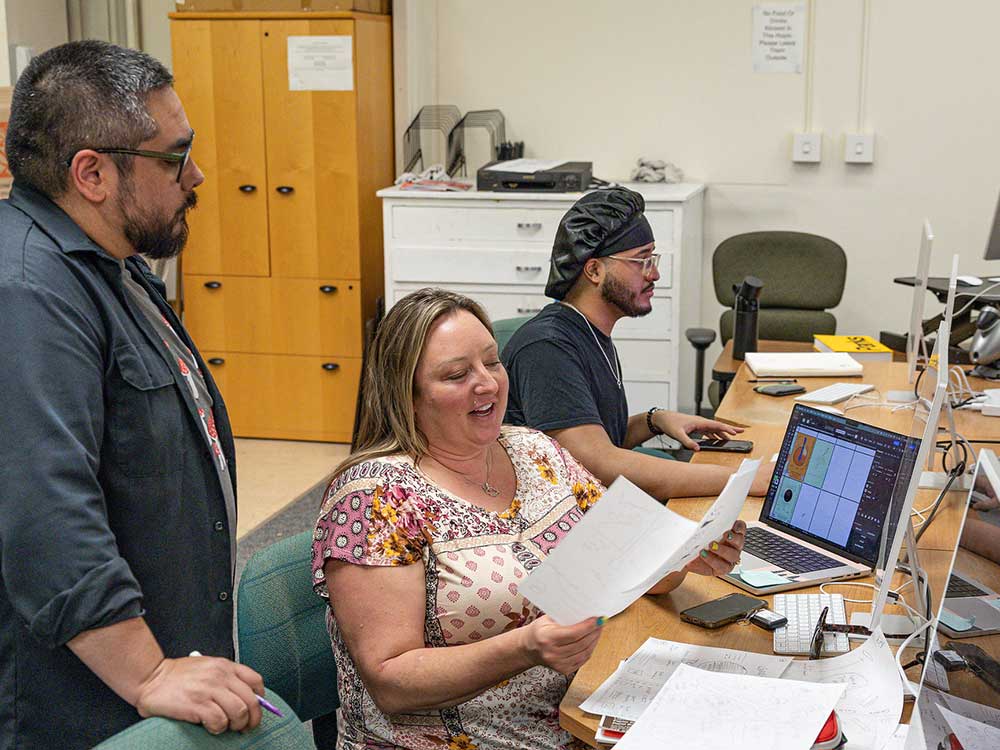
A student seeks input from Applied Art and Design instructor Vincent Pacheco.
Sierra Journal 2025 Launch Party
Writers read their published works and designers discussed their process at the Sierra Journal Launch Party.